Phase 09 - Lesson 12
RL for Games — AlphaZero, MuZero, and the LLM-Reasoning Era
This lesson includes a graded coding exercise that runs in your browser, unlocked with lifetime access.
1992: TD-Gammon beat human champions at backgammon with pure TD. 2016: AlphaGo beat Lee Sedol. 2017: AlphaZero dominated chess, shogi, and Go from scratch. 2024: DeepSeek-R1 proved the same recipe, with GRPO replacing PPO, works on reasoning. Games are the benchmark that drives every breakthrough in this phase.
Type: Build Languages: Python Prerequisites: Phase 9 · 05 (DQN), Phase 9 · 08 (PPO), Phase 9 · 09 (RLHF), Phase 9 · 10 (MARL) Time: ~120 minutes
The Problem
Games have everything RL wants. Clean reward (win/loss). Infinite episodes (self-play resets). Perfect simulation (the game is the simulator). Discrete or small continuous action spaces. Multi-agent structure that forces adversarial robustness.
And games are how every major RL breakthrough was tested. TD-Gammon (backgammon, 1992). Atari-DQN (2013). AlphaGo (2016). AlphaZero (2017). OpenAI Five (Dota 2, 2019). AlphaStar (StarCraft II, 2019). MuZero (learned model, 2019). AlphaTensor (matrix multiplication, 2022). AlphaDev (sorting algorithms, 2023). DeepSeek-R1 (math reasoning, 2025) — the latest demonstration that game-RL techniques work on text.
This capstone surveys the three landmark architectures — AlphaZero, MuZero, and GRPO — through a single unifying lens: self-play + search + policy improvement. Each generalizes the previous; GRPO in particular is AlphaZero's recipe applied to LLM reasoning, with tokens as actions and mathematical verification as the win signal.
The Concept
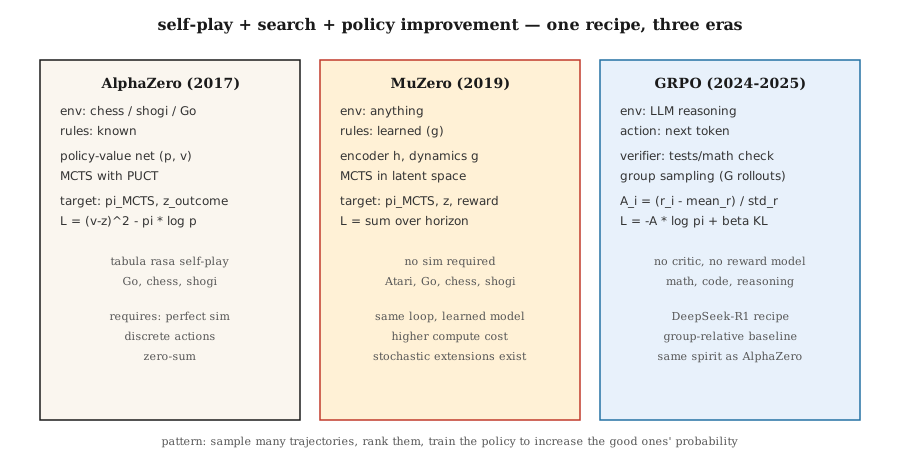
The unifying loop.
while True:
    trajectory = self_play(current_policy, search)     # play game against self
    policy_target = search.improved_policy(trajectory) # search improves raw policy
    policy_net.update(policy_target, value_target)     # supervised on search output
AlphaZero (2017). Silver et al. Given a game (chess, shogi, Go) with known rules:
- Policy-value network: one tower
f_θ(s) → (p, v).pis a prior over legal moves.vis the expected game outcome. - Monte Carlo Tree Search (MCTS): at each move, expand a tree of possible continuations. Use
(p, v)as the prior + bootstrap. Select nodes by UCB (PUCT):a* = argmax Q(s, a) + c · p(a|s) · √N(s) / (1 + N(s, a)). - Self-play: play games agent-vs-agent. At move
t, the MCTS visit distributionπ_tbecomes the policy training target. - Loss:
L = (v - z)² - π · log p + c · ||θ||².zis the game outcome (+1 / 0 / -1).
Zero human knowledge. Zero handcrafted heuristics. A single recipe that mastered chess, shogi, and Go after a few tens of millions of self-play games each.
MuZero (2019). Schrittwieser et al. Removes the requirement that the rules are known.
- Instead of a fixed environment, learn a latent dynamics model
(h, g, f):h(s): encode observation to latent state.g(s_latent, a): predict next latent state + reward.f(s_latent): predict policy prior + value.
- MCTS runs in the learned latent space. Same search, same training loop.
- Works on Go, chess, shogi and Atari — one algorithm, no rule knowledge.
Stochastic MuZero (2022). Adds stochastic dynamics and chance nodes; extends to backgammon-class games.
Muesli, Gumbel MuZero (2022-2024). Improvements on sample efficiency and deterministic search.
GRPO (2024-2025). DeepSeek-R1 recipe. Same AlphaZero-shaped loop, applied to language-model reasoning:
"Game": answer a math / coding / reasoning problem. "Win" = verifier (test case passes, numerical answer matches) returns 1.
Policy: the LLM. Actions: tokens. State: prompt + response-so-far.
No critic (PPO-style V_φ). Instead, for each prompt, sample
Gcompletions from the policy. Compute reward for each. Use the group-relative advantageA_i = (r_i - mean_r) / std_ras the signal for REINFORCE-style update.KL penalty to reference policy to prevent drift (like RLHF).
Full loss:
L_GRPO(θ) = -E_{q, {o_i}} [ (1/G) Σ_i A_i · log π_θ(o_i | q) ] + β · KL(π_θ || π_ref)
No reward model, no critic, no MCTS. Group-relative baseline replaces all three. Matches or exceeds PPO-RLHF quality on reasoning benchmarks at a fraction of the compute.
The R1 recipe in full. DeepSeek-R1 (DeepSeek 2025) is two models in one paper:
- R1-Zero. Start from the DeepSeek-V3 base model. No SFT. Apply GRPO directly with two reward components: accuracy reward (rule-based — did the final answer parse to the correct number / did the code pass unit tests) and format reward (did the completion wrap its chain-of-thought in
<think>…</think>tags). Over thousands of steps, average response length grows from ~100 to ~10,000 tokens and math benchmark scores climb to near-o1-preview levels. The model learns to reason from scratch. The downside: its chains of thought are often unreadable, mix languages, and lack stylistic polish. - R1. Fix R1-Zero's readability problems with a four-stage pipeline:
- Cold-start SFT. Collect a few thousand long-CoT demonstrations with clean formatting. Supervised-finetune the base model on them. This gives a readable starting point.
- Reasoning-oriented GRPO. Apply GRPO with the accuracy+format rewards plus a language-consistency reward to prevent code-switching.
- Rejection sampling + SFT round 2. Sample ~600K reasoning trajectories from the RL checkpoint, keep only those with correct final answers and readable CoT, and combine with ~200K non-reasoning SFT examples (writing, QA, self-cognition). Fine-tune the base again.
- Full-spectrum GRPO. One more RL round covering both reasoning (rule-based rewards) and general alignment (helpfulness/harmlessness preference-based rewards).
The result matches o1 on AIME and MATH-500 at open weights, and is small enough to distill. The same paper also releases six distilled dense models (Qwen-1.5B through Llama-70B) by SFT'ing on R1's reasoning traces — no RL at the student. Distillation of a strong RL teacher consistently beats RL from scratch at the student's scale.
Why GRPO instead of PPO for reasoning. Three reasons in the DeepSeekMath paper (Feb 2024): (1) no value network to train, halving memory; (2) the group baseline naturally handles the sparse end-of-trajectory reward that reasoning tasks produce; (3) per-prompt normalization makes advantages comparable across problems of wildly different difficulty, which PPO's single critic cannot.
Search-free vs search-based. Games have branched:
- Perfect-information games with long horizons (Go, chess): still search-based. AlphaZero / MuZero dominate.
- LLM reasoning: no MCTS yet in production; GRPO on full rollouts, best-of-N for inference compute. Process reward models (PRMs) hint at step-level search being added back.
Build It
The code in code/main.py implements GRPO in miniature — a bandit with multiple groups of samples. The algorithm is the same as on an LLM; only the policy and environment are simpler. It teaches the loss and the group-relative advantage, which is the 2025 innovation.
Step 1: a tiny verifier environment
QUESTIONS = [
    {"prompt": "q1", "correct": 3},
    {"prompt": "q2", "correct": 1},
]

def verify(prompt_idx, answer_token):
    return 1.0 if answer_token == QUESTIONS[prompt_idx]["correct"] else 0.0
In real GRPO the verifier runs unit tests or checks math equality.
Step 2: policy: softmax over K answer tokens per prompt
def policy_probs(theta, p_idx):
    return softmax(theta[p_idx])
Equivalent to the final-layer output of an LLM conditioned on a prompt.
Step 3: group sampling and group-relative advantage
def grpo_step(theta, p_idx, G=8, beta=0.01, lr=0.1, rng=None):
    probs = policy_probs(theta, p_idx)
    samples = [sample(probs, rng) for _ in range(G)]
    rewards = [verify(p_idx, s) for s in samples]
    mean_r = sum(rewards) / G
    std_r = stddev(rewards) + 1e-8
    advs = [(r - mean_r) / std_r for r in rewards]

    for a, A in zip(samples, advs):
        grad = onehot(a) - probs
        for i in range(len(probs)):
            theta[p_idx][i] += lr * A * grad[i]
    # KL penalty: pull theta toward reference
    for i in range(len(probs)):
        theta[p_idx][i] -= beta * (theta[p_idx][i] - reference[p_idx][i])
The group-relative advantage is the 2024 DeepSeek trick. No critic needed. The "baseline" is the group mean, and normalization uses group std.
Step 4: compare to REINFORCE baseline (value-free)
Same setup, same compute, plain REINFORCE. GRPO converges faster and more stably.
Step 5: observe entropy and KL
Same diagnostics as RLHF: mean KL to reference, policy entropy, reward-over-time. Once these stabilize, training is done.
Pitfalls
- Reward hacking via verifier gaming. GRPO inherits RLHF's risk: if the verifier is wrong or exploitable, the LLM will find the exploit. Robust verifiers (multiple test cases, formal proofs) matter.
- Group size too small. Variance of the group baseline goes like
1/√G. BelowG = 4, the advantage signal is noisy; standard choice isG = 8to64. - Length bias. LLM completions of different lengths have different log-probabilities. Normalize by token count, or use sequence-level log-prob, or truncate to max length.
- Pure self-play cycles. AlphaZero-style training can get stuck in dominance loops on general-sum games. Mitigated by diverse opponent pools (league play, Lesson 10).
- Search-policy mismatch. AlphaZero trains the policy to mimic search output. If the policy net is too small to represent the search's distribution, training stalls.
- Compute floor. MuZero / AlphaZero need massive compute. A single ablation is often hundreds of GPU-hours. Miniature demos exist (e.g., AlphaZero on Connect Four) for learning.
- Verifier coverage. Unit tests that pass for a buggy solution reinforce the bug. Design verifiers that catch edge cases.
Use It
The 2026 game-RL landscape, by domain:
| Domain | Dominant method |
|---|---|
| Two-player zero-sum board games (Go, chess, shogi) | AlphaZero / MuZero / KataGo |
| Imperfect info card games (poker) | CFR + deep learning (DeepStack, Libratus, Pluribus) |
| Atari / pixel games | Muesli / MuZero / IMPALA-PPO |
| Large multiplayer strategy (Dota, StarCraft) | PPO + self-play + league (OpenAI Five, AlphaStar) |
| LLM math/code reasoning | GRPO (DeepSeek-R1, Qwen-RL, open replications) |
| LLM alignment | DPO / RLHF-PPO (not GRPO; verifier is preference not verifiable) |
| Robotics | PPO + DR (not game-RL, but uses same policy-gradient tools) |
| Combinatorial problems | AlphaZero variants (AlphaTensor, AlphaDev) |
The recipe — self-play, search-augmented improvement, policy distillation — spans text, pixels, and physical control. GRPO is the youngest instance; more are coming.
Ship It
Save as outputs/skill-game-rl-designer.md:
---
name: game-rl-designer
description: Design a game-RL or reasoning-RL training pipeline (AlphaZero / MuZero / GRPO) for a given domain.
version: 1.0.0
phase: 9
lesson: 12
tags: [rl, alphazero, muzero, grpo, self-play]
---

Given a target (perfect-info game / imperfect-info / Atari / LLM reasoning / combinatorial), output:

1. Environment fit. Known rules? Markov? Stochastic? Multi-agent? Informs AlphaZero vs MuZero vs GRPO.
2. Search strategy. MCTS (PUCT with learned prior), Gumbel-sampled, best-of-N, or none.
3. Self-play plan. Symmetric self-play / league / offline data / verifier-generated.
4. Target signal. Game outcome / verifier reward / preference / learned model. Include robustness plan.
5. Diagnostics. Win rate vs baseline, ELO curve, verifier pass rate, KL to reference.

Refuse AlphaZero on imperfect-info games (route to CFR). Refuse GRPO without a trusted verifier. Refuse any game-RL pipeline without a fixed baseline opponent set (self-play ELO is uncalibrated otherwise).
Exercises
- Easy. Implement the GRPO bandit in
code/main.py. Train on 2 prompts × 4 answer tokens each. Converge in < 1,000 updates withG=8. - Medium. Plug in PPO (clipped) and vanilla REINFORCE. Compare sample efficiency and reward variance to GRPO on the same bandit.
- Hard. Extend to a length-2 "reasoning chain": the agent emits two tokens and the verifier rewards the pair. Measure how GRPO handles the credit assignment across two-step sequences. (Hint: compute group advantage per full sequence, propagate to both token positions.)
Key Terms
| Term | What people say | What it actually means |
|---|---|---|
| MCTS | "Tree search with learned net" | Monte Carlo Tree Search; UCB1/PUCT selection with learned (p, v) priors. |
| AlphaZero | "Self-play + MCTS" | Policy-value net trained to match MCTS visits and game outcome. |
| MuZero | "Learned-model AlphaZero" | Same loop but in latent space via learned dynamics. |
| GRPO | "Critic-free PPO" | Group Relative Policy Optimization; REINFORCE with group-mean baseline + KL. |
| PUCT | "AlphaZero's UCB" | Q + c · p · √N / (1 + N_a) — balances value estimate with prior. |
| Self-play | "Agent vs past self" | Standard for zero-sum; symmetric training signal. |
| League play | "Population-based self-play" | Past + current + exploiters sampled as opponents. |
| Verifier reward | "Verifiable RL" | Reward comes from a deterministic checker (tests pass, answer matches). |
| Process reward | "PRM" | Scores each reasoning step, not just the final answer. |
Further Reading
- Silver et al. (2017). Mastering the game of Go without human knowledge (AlphaGo Zero).
- Silver et al. (2018). A general reinforcement learning algorithm that masters chess, shogi, and Go through self-play (AlphaZero).
- Schrittwieser et al. (2020). Mastering Atari, Go, chess and shogi by planning with a learned model (MuZero).
- Vinyals et al. (2019). Grandmaster level in StarCraft II (AlphaStar).
- DeepSeek-AI (2024). DeepSeekMath: Pushing the Limits of Mathematical Reasoning in Open Language Models (GRPO) — the paper that introduced GRPO and the group-relative baseline.
- DeepSeek-AI (2025). DeepSeek-R1: Incentivizing Reasoning Capability in LLMs via Reinforcement Learning — the full four-stage R1 recipe plus the R1-Zero ablation.
- Brown et al. (2019). Superhuman AI for multiplayer poker (Pluribus) — CFR + deep-learning at scale.
- Tesauro (1995). Temporal Difference Learning and TD-Gammon — the paper that started it all.
- Hugging Face TRL — GRPOTrainer — the production reference for applying GRPO with custom reward functions.
- Qwen Team (2024). Qwen2.5-Math — GRPO replication — open replication of the R1 recipe at multiple scales.
- Sutton & Barto (2018). Ch. 17 — Frontiers of Reinforcement Learning — the textbook framing for self-play, search, and "designed reward" that R1 instantiates at LLM scale.